

DIS/ABLED DESIGN:
SLOW. RESPONSIVE. COLLABORATIVE. HUMAN.

Designing for Dis/abled users is really just designing to communicate in many possible ways. Individual modes of communication vary so widely, there is no way for any one person to dictate the best way to meet them all. I have adopted a philosophy and method of slow, responsive, collaborative design, in which I co-create experiences with the individuals with the individuals who use them.
-
At a moment characterized by mass production, Dis/abled design asks us to take a slower, more methodical approach that centers human experience. Working within systems and structures that marginalize Dis/abled users and experiences, slowing down and deliberately designing for these users is the only way to consider and include diverse abilities, and new possibilities into design workflows.
-
“Responsive,” in a design context, usually refers to reformatting content based on a screen’s size and shape. This is one small, but important feature of a broader definition of responsive design, which reacts and enacts change based on the needs of the user. In cases of designing for Dis/abled people, this means determining the best design tools, strategies, and decisions with the Dis/abled individuals at hand.
You cannot be responsive if you are not also collaborative. I see my role more as a co-creator in any project. Design is only as good as its ability to serve its users, and the principles of “Universal” Design demonstrate that Dis/abled access helps everyone. The best way to build a product or experience that serves your needs, is to invite you into the design process and create a supportive experience, together.
-
Generative content is not designed. It is an estimated amalgamation of a collective body of work but human designers. It does not make decisions, check its ethics, or center Dis/abled user experiences. Between the energy and environmental consumption, the theft of creative works by generations of human designers, and what I believe is a fast-moving, collective loss of critical design and decision-making, I prefer designs made intentionally for human users, by human designers.
I work in a field that relies increasingly on generative AI content. If I didn’t engage and understand these tools, I would have a hard time justifying ignoring it's scale potential. However, my familiarity with AI tools only further cements my belief that only humans can design for humans, and generative content is the enemy of creative voice.
Graphic Design
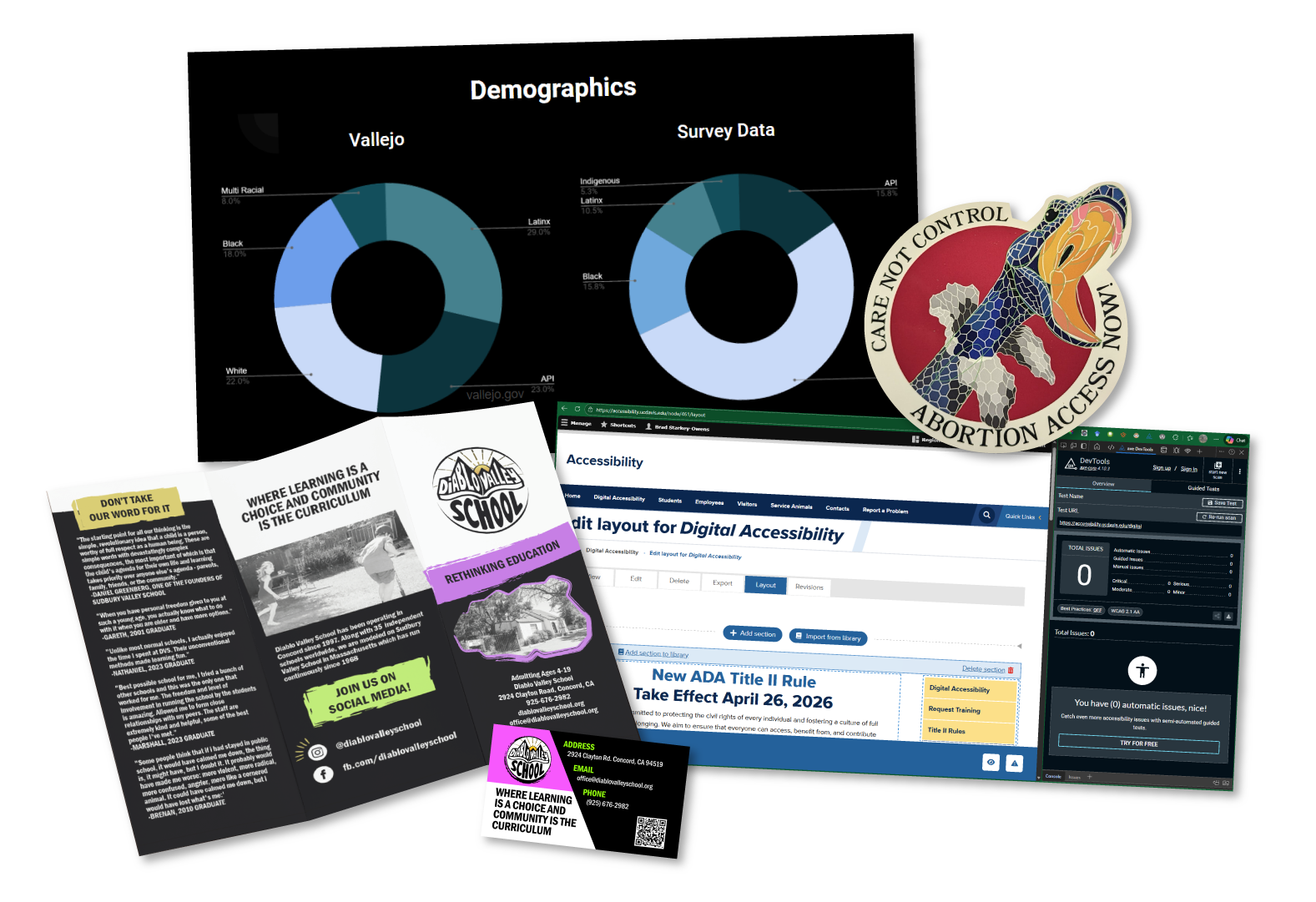
I am a skilled and experienced Graphic Designer, having worked with high profile clients like Alaska Airlines and UC Davis, as well as small, local orgs and businesses.
My real focus is designing for multiple formats. This means developing content in a well-structured and easily translatable form, then personalizing it for Dis/abled individual users’ needs. Centering Dis/abled users doesn’t complicate a design workflow, it just asks us to consider usability from the first stages of development.
-
In my roles I have worked with vendors including Adobe, Instructure, ServiceNow, Freedom Scientific, as well as emerging startups and tech companies to find opportunities to improve functional access alongside compliance efforts. Accessibility compliance is important, but it doesn't address all the ways Dis/abled people are left out of digital and design spaces.
I train Graphic Designers to use, or not use, industry standard software suites to create Accessible files and experiences for Dis/abled users. I try to provide free accessible resources, openly available online. This is a privilege, so please take advantage of any templates or guides you find helpful
-
I develop content in easily manipulated formats so they can be easily published to multiple platforms, or converted for Digital Accommodations. I train designers, content editors, and faculty to draft in text docs or HTML so styles and hierarchy are easily maintained and reproduced.
Often referred to as “Alternate Media” or “Alternate Formats,” I prefer to think of it more as flexible content. Publishing to Accessible platforms is not alternative to an inaccessible norm; it’s just versatile and widely usable design.
-
I have built Accessibility programs for multiple colleges and universities, and the problem of how to manage or remediate PDFs is reliably tough to solve. I have launched campus-wide remediation programs piloting emerging tools like Equidox, Siteimprove, and DocAccess to identify and remediate inaccessible PDFs at scale. My ideal solution though: get rid of PDFs, whenever you can.
PDFs serve an important print purpose, but for online hosting and screen presentation, we have far more dynamic and Accessible solutions. I have provided guidance and programs design for PDF remediation and replacement programs at Sonoma State University, Southwest Community College, and am currently training faculty and staff at UC Davis ok leveraging existing formats like HTML and Google Docs,.or newer solutions like Notion to redesign content in a responsive,.dynamic format that centers and enables usability with multiple navigation methods.
We know HTML, Google Docs, and other responsive platforms work better on screens. Yes, because they mesh with screen readers and magnifiers, but they are also just more engaging and responsive for any user.
My Accessible Freeware Trello Board includes a number of authoring platforms that encourage responsive, Accessible content development from the outset, and not as an export afterthought.
-
I have a special interest in logo design, and meeting the sensory and communication needs or especially visually and cognitively impaired users. I enjoy solving the problem of representing a brand's purpose, values, and mission utilizing intuitive, diverse, and high-contrast communication methods. I have been fortunate to put my interest to work for companies and organizations in the Sacramento and San Francisco Bay Area, including work for the State of California, the California Community Colleges, and many independent and nonprofit organizations.
My Guide for Accessible Logo Design walks designers through steps to ensuring graphic elements are as Accessible as possible, taking into account visual communication methods, color contrast, font selection, and other considerations that will demonstrate a commitment to Dis/abled users. If you represent a mutual aid network, independent learning community, or other grassroots organization, please contact me to request Accessible, pro-bono logo design.
Learning Design
Dis/abled learning spaces take countless shapes, from “traditional” classrooms, to outdoor adventures, or captioned Zoom classrooms safely from home. There is no one-size-fits all solution for optimal learning conditions. My job, as an educator and Dis/abled advocate, is to be responsive to each student’s needs, and have as many tools at my disposal as possible.
-
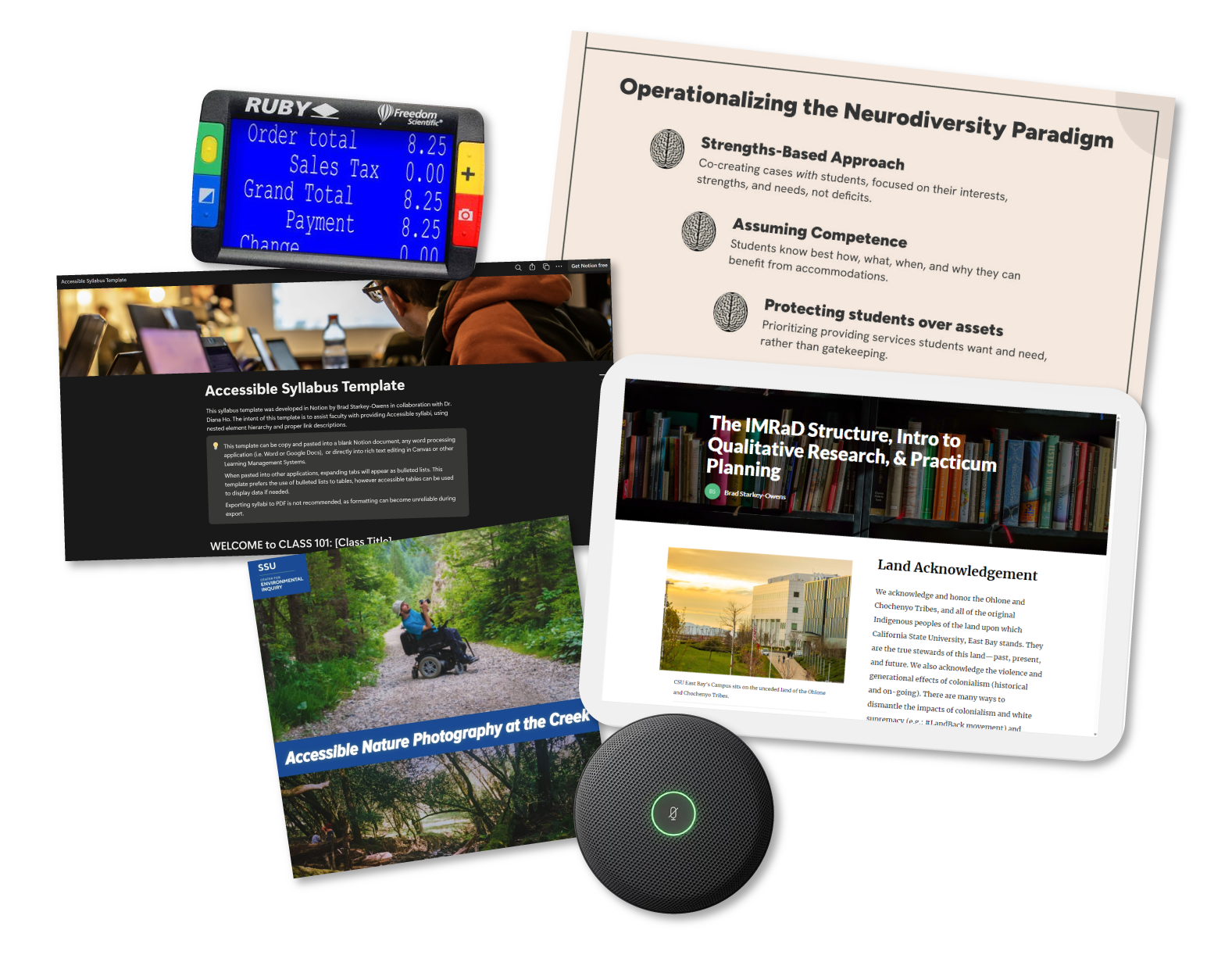
I’ve worked with Alt Media and Assistive Tech for over a decade and have come to believe that all students benefit from the ability to choose their preferred format and modality when learning new materials, regardless of age or institution. I have have worked as an Alternate media and Assistive Technology Specialist and Trainer, and advised on rebuilding and rewriting Alternate Media standards for the California Community College system in 2024.
“Alternate” formats and assistive technology are essential components to student support and should be available for all instructional methods and materials. As an educator and advocate, I am committed to serving students by creating environments where they are truly supported, not just rhetorically, and empowered to utilize audiobooks, captioned videos, text dictation tools, or whatever they deem works best for their particular set of abilities. As an author and designer, that makes my responsibility to work in flexible, responsive formats essential to their success.
-
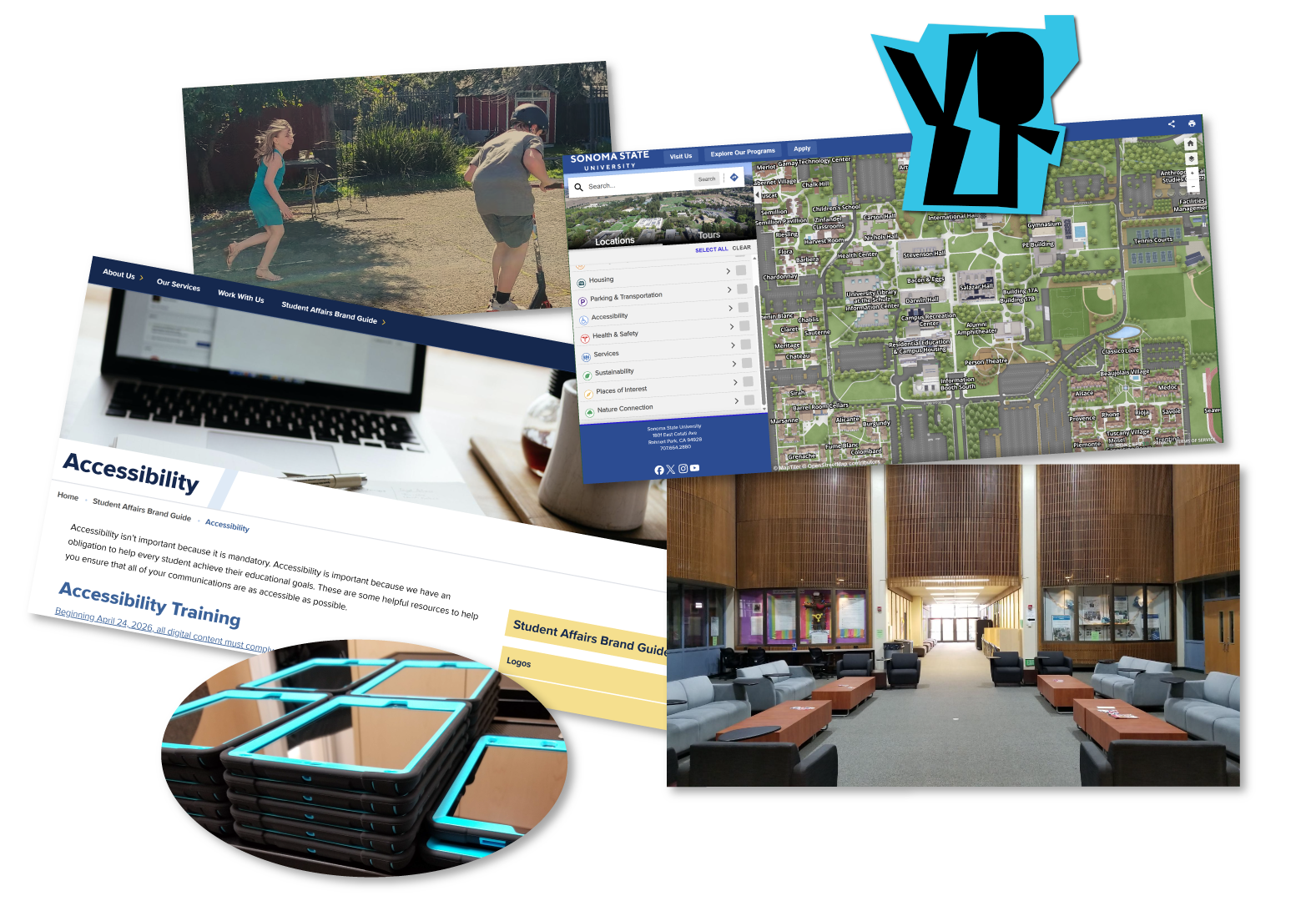
Learning spaces should be as flexible and adaptive as any student may need. In my work with schools, I have designed and advocated for classrooms that are equipped to support Dis/abled students in any capacity. At Sonoma State University, I assisted in the development of outdoor classrooms that meet the hands-on pedagogical requirements of faculty, while maintaining physically accessible spaces, as well as reliable power and network resources to support assistive listening devices and real-time captioning services.
-
I collaborate with university faculty to solve Instructional Design problems at the intersection of student-centered pedagogy and Universal Design for Learning (UDL).
In collaboration with UC Davis’s Professors of Teaching Community of Practice (PoT CoP), I am developing an Access Pedagogy Project, which seeks to find and develop new tools with the belief that good teaching practice can’t be inaccessible, and Accessibility standards shouldn’t conflict with good pedagogy. This project began in Summer 2025 and will extend into 2027.
In collaboration with Dr. Diana Ho I have developed an Accessible Syllabus template, which can be copied directly out of Notion, and pasted into any Accessible platform of an instructor’s choice.
Institutional Design
-
I work closely with the staff and students at Diablo Valley School, a Democratic K12 school in the East Bay Area. DVS is unique to other schools in their commitment to self-direction. When I help design support programs for Dis/abled students, I am working directly with the students they seek to serve. True Self-Direction for Dis/abled students, with community responsibility, is the key to fostering capable, self-determined adults who know what kinds of support they need, and how to go about getting them.
I am a Co-Founder and Program Director for Vallejo Open Learning Trust, a grassroots organization in Vallejo, Californa that seeks to provide self-determined learning opportunities through robust pedagogical and technology offerings, voluntary academic coaching and graduation cohorts, and working relationships with nearby companies, organizations, and colleges to ensure parallel support and opportunities. VOLT is in its infancy, and intended as a low-to-no-cost institution for Dis/abled and Neurodivergent students negatively affected by Federal and local funding cuts to public education.
-
As an Accessibility Analyst at Sonoma State University, and now as the Digital Accessibility Program Manager at UC Davis, I understand how to design and execute a Digital Accessibility program to meet the needs of a large campus. By providing programmatic structure, technical support, and Universal Design training through role-specific training and resources, I have been highly successful at building Accessibility skills and buy-in from stakeholders across the institution.
By and large most people want to do what’s best by Dis/abled students and users. But, they feel limited by time, lacking support resources, and competing priorities. My job is to justify and provide resources to whatever extent I can, then build methodical programs that address Accessibility on a realistic, risk-based timeline.
-
My Dis/abled Services career started by providing digital accommodations. Today I train staff, speak at conferences, and design blueprints for restructuring programs in an affirming an student-centered manner.
I believe in providing radical access to services, before any need is “justified” or diagnostic paperwork is requested. Many students lack medical insurance, or the ability to otherwise pursue medical diagnoses. Schools who require diagnostic paperwork, a lengthy validation process, and/or allow only for automatic confirmation of visually apparent disabilities, create an inequitable pathway to services that disadvantages students who are low-income, have an invisible disability, and/or are femme or BIPOC and may not match research performed on White young men.
Providing services first, and finding out details through relationship and ongoing interaction are the only way to equitable accommodations.
My technical roles have become leadership positions, either officially or functionally, in every school or organization I’ve worked with. In getting to the root of technical issues, I have found myself leading committees, departments, or entire institutions toward greater access.